Every sourcing event starts with a choice that shapes everything after it: how to ask suppliers for what you need. Ask the wrong way and the responses come back unusable, either too thin to judge or too elaborate to compare. Two documents handle most of that work, and they are easy to confuse.
A Request for Quotation (RFQ) and a Request for Proposal (RFP) both invite suppliers into a sourcing event, but they differ in scope and intent. An RFQ fits when an organization knows exactly what it needs and wants competitive pricing and delivery terms. An RFP fits when requirements are complex or outcome-focused, so the organization wants detailed proposals covering methods, project approach, and added value. Choosing correctly aligns the sourcing event with the business need, protects compliance, and gets the most from every supplier conversation.
Understanding the RFQ
An RFQ is a formal process for buying against clearly defined specifications or a bill of materials. The goal is competitive bids on price, delivery, and basic commercial terms, and little else. RFQs suit commoditized goods and standardized services, where the real question is which compliant supplier can deliver at the best cost.
The typical scenario is a routine or repeat purchase, or any purchase where the requirements are already settled. Suppliers respond with unit cost, lead time, and payment terms, sometimes with light credentials attached. Evaluation is largely quantitative. The winning bid is usually the lowest qualified one that meets every stated requirement.
That structure makes RFQs efficient. Supplier responses arrive in a standard format, and side-by-side comparison takes minutes rather than days. The trade-off is flexibility. An RFQ leaves suppliers little room to propose a better alternative, because it was never asking for one.
Understanding the RFP
An RFP comes into play when the buying need is complex, the specifications are incomplete, or the organization wants to judge a supplier’s methods and expertise alongside price. Strategic projects, consulting engagements, IT deployments, construction, and solution sourcing all tend to call for RFPs. In each case, supplier input can genuinely improve the outcome.
RFP scenarios involve unstructured needs, bespoke projects, outcome-based contracts, and services that suppliers might deliver in very different ways. Responses carry much more weight. Suppliers submit technical solutions, project methodology, relevant experience, and pricing models, and sometimes risk assessments or Service Level Agreements (SLAs). Evaluation uses weighted scoring that blends qualitative and quantitative criteria, typically covering capability, approach, compliance, and total value.
The payoff is access to a wider range of ideas, stronger value, and lower risk through thorough supplier vetting. The cost is effort. An RFP demands more planning upfront and considerably more time to review responses.
The Key Differences
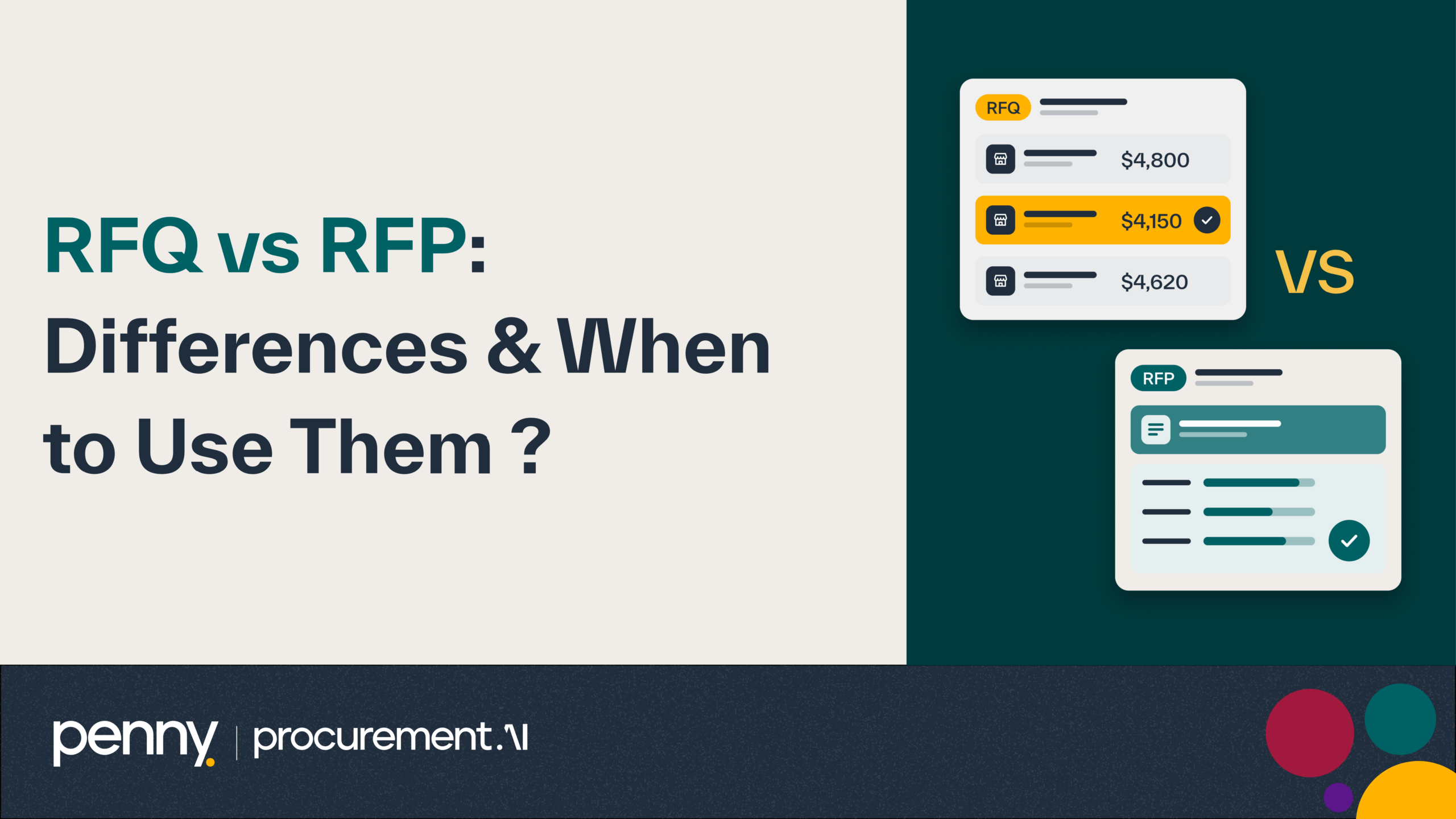
Set side by side, the two diverge on almost every dimension. An RFQ serves standard goods and services with well-defined requirements. An RFP serves complex solutions and open-ended or outcome-focused needs. RFQ responses cover price, delivery, and minor commercial terms. RFP responses cover the proposed approach, technical solution, credentials, and price together.
Evaluation follows the same split. RFQs rest mainly on price and compliance, while RFPs weigh capability, value, and methodology alongside cost. Supplier innovation is largely absent from an RFQ but actively invited in an RFP. Procurement effort differs too. An RFQ stays lean and transactional, while an RFP usually needs a cross-functional review team.
When to Use Each
Reach for an RFQ when the product or service is standardized and driven by specification. It is the right tool when there is little room for alternative solutions and the priority is the lowest cost from a compliant supplier. RFQs also make sense when time to award matters and process overhead needs to stay minimal.
Reach for an RFP when you need supplier expertise, innovative solutions, or flexibility in how the work gets done. It suits scopes that are complex or open-ended, and situations where value, partnership, and performance carry as much weight as cost. RFPs also fit when risk, compliance, or regulatory considerations demand careful evaluation rather than a quick price comparison.
Getting the choice right speeds up sourcing, limits compliance risk, and keeps every event aligned with budget and operational goals.
The Strategic Implications
The choice between RFQ and RFP reaches well beyond the sourcing event itself. RFQs keep operational purchasing fast, moving requests to award quickly and feeding clean, structured pricing into the purchase orders that follow. RFPs build strategic supplier relationships, support value engineering, and lay the groundwork for long-term contract management.
Organizations that set clear decision rules for when each process applies, and run both through digital workflows, gain twice. Maverick spend falls, and spend under management rises.
How Penny AI Solves RFQ and RFP Needs
The Penny AI system offers dedicated RFQ and RFP capabilities, so organizations can configure sourcing workflows that match the complexity of each buying need. Teams launch events, invite suppliers, issue templated documents, and evaluate responses all in one audit-ready environment. Automated scoring supports transparent side-by-side evaluation, whether the event is a commodity RFQ or a complex RFP.
Flexible approval workflows match oversight to the value and risk of each event, so strategic RFPs get proper scrutiny while compliant RFQs move quickly. Supplier tracking and integration with Penny AI contract management carry awarded terms forward into the agreements that follow. Procurement leaders manage tactical and strategic sourcing side by side, in one central place.
الأسئلة الشائعة
When should I use an RFQ instead of an RFP?
Use an RFQ when requirements are clearly defined and the main goal is comparing suppliers on price and terms. Standardized products, small-scale services, and repeat purchases with little need for customization are the common cases.
What are typical evaluation criteria for an RFP?
RFPs combine qualitative and quantitative factors. These include supplier capability, methodology, compliance with requirements, project timelines, and total cost of ownership. Weighted scoring matrices keep the comparison objective across very different proposals.
Can the same need be handled by either an RFQ or an RFP?
Occasionally, in borderline cases. Even then, the risks are real. An RFQ for a complex need can produce an inadequate solution, while an RFP for a straightforward purchase adds complexity nobody needed. Matching the process to the complexity keeps sourcing efficient.
What happens if you choose the wrong process?
An RFQ for a strategic, complex requirement often yields the cheapest option rather than the right one. Defaulting to RFPs for simple needs slows procurement and adds administrative burden. Either way, value and compliance suffer.
How do structured RFQ and RFP processes improve compliance?
Structured processes centralize supplier data, strengthen auditability, and create clear documentation for every sourcing decision. Maverick spend falls, and the organization meets regulatory and internal policy requirements more easily.
الخاتمة
The difference between an RFQ and an RFP is not really about paperwork. It comes down to what kind of answer you need from suppliers. When you already know exactly what to buy, you need a price, and an RFQ gets it quickly and comparably. When you know the outcome but not the best route to it, you need a proposal, and an RFP draws out the thinking that suppliers can contribute. Most sourcing mistakes in this area come from habit, such as running every event the same way regardless of what is being bought. Clear decision rules break that habit. Each event gets the process it deserves, and supplier responses arrive in a form your team can actually use.