Most procurement teams do not suffer from a shortage of process. They suffer from too many of them, spread across disconnected tools. A request starts in a form and moves to email for approval. It lands in a spreadsheet for sourcing, then gets re-keyed into an accounting system weeks later. Every handoff loses data, skips policy, and burns time.
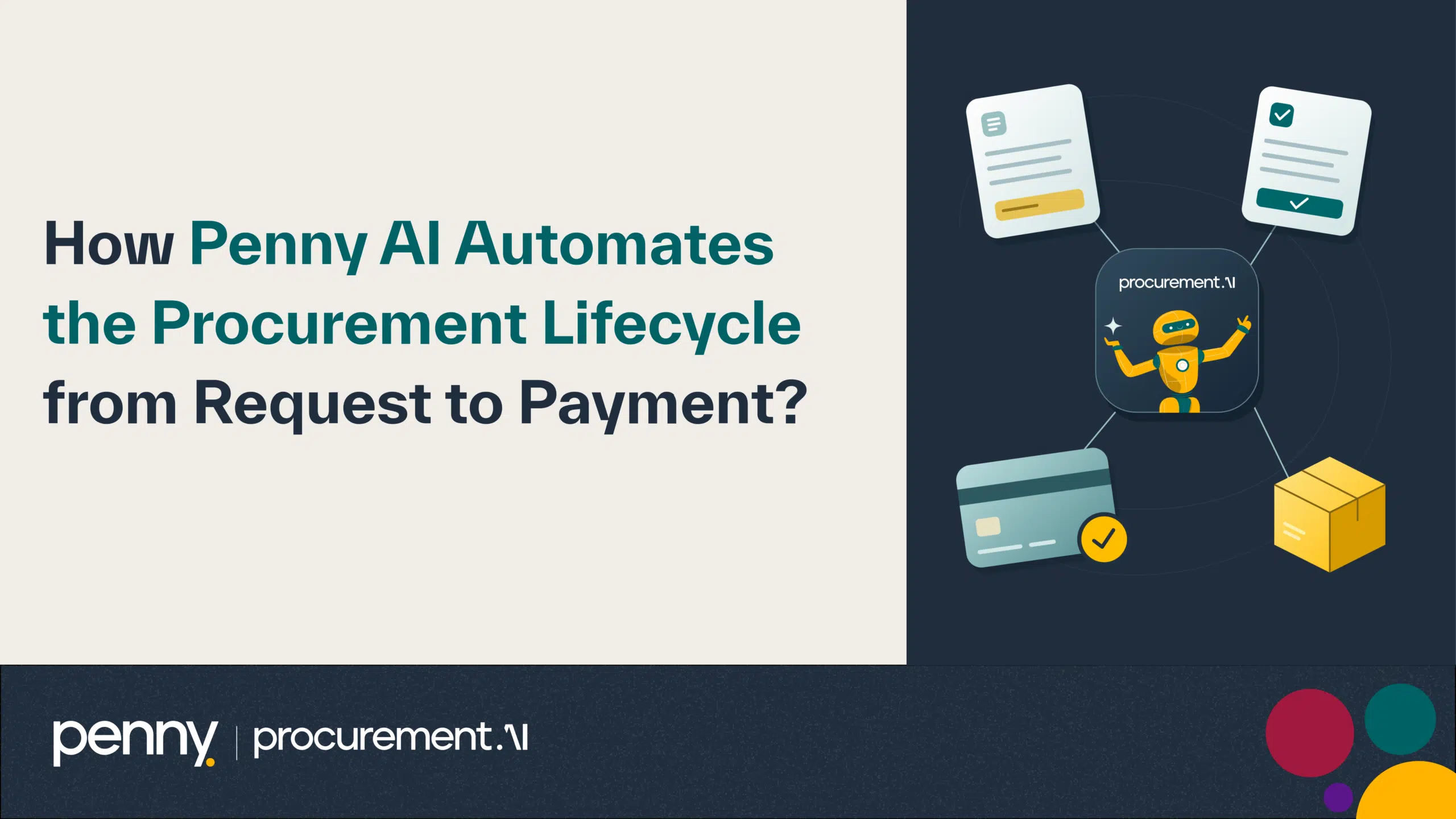
Penny AI automates that lifecycle from the first request through to final payment. Unified workflows, AI-driven decision support, and real-time collaboration all run in one system. The coverage spans request creation, sourcing events, supplier collaboration, and purchase order management. It extends through contract administration to the invoice and payment controls finance teams depend on. Each stage runs on embedded AI, data validation, and configurable approval structures. The outcome is less manual work, lower risk, and stronger compliance. One auditable procurement record replaces a dozen partial ones.
The Modern Procurement Lifecycle
The procurement lifecycle describes how an organization identifies a need and sources suppliers. It then buys goods or services, manages the resulting contracts, and controls payment. In its traditional form, that journey crosses several unconnected solutions. Documents move by hand, approvals happen over email, and data errors accumulate quietly. Maverick spend thrives in the gaps. Digital automation makes the same journey transparent and auditable. Central data carries it, and AI sharpens each step.
Stage One: Requisition Initiation
Employees submit purchase requests through guided, configurable forms. Those forms capture the data procurement actually needs. They also enforce policy from the start, rather than catching problems three approvals later. Penny AI checks each submission before it enters the approval chain. It detects duplicate requests, missing information, and categories that do not match the description. Requesters fix issues while the request is still theirs to fix.
Stage Two: Sourcing and RFx Automation
Penny AI orchestrates Requests for Quotation (RFQs) and Requests for Proposal (RFPs) using templates. Every event follows a consistent structure. Supplier responses arrive in one place and build into automatic comparison matrices. Nobody reconciles a folder of attachments. The AI reviews incoming bids and flags outliers and compliance risks before anyone draws up a shortlist. Sourcing leads then spend their attention on judgment rather than arithmetic.
Stage Three: Supplier Collaboration and Onboarding
Suppliers register themselves through a secure portal and maintain their own profiles afterward. Key data fields, certifications, and compliance documents live in the system digitally. Onboarding shortens, and a common source of manual error disappears. Suppliers keep their own records current, so the data stays accurate long after initial setup. That is usually where traditional supplier databases start to decay.
Stage Four: Purchase Order Management
Approved requisitions convert automatically into digital purchase orders. Each one carries transparent status tracking and a complete audit trail. Penny AI validates vendor selection, pricing, and contracted terms at the point of issue. A purchase order that drifts from an agreed contract gets caught before it reaches the supplier. That is how automation prevents maverick spend instead of discovering it later.
Stage Five: Contract Lifecycle Automation
Drafting, negotiation, renewals, and compliance monitoring all run in one place. Automated reminders and defined approval chains keep each one moving. Every contract version and supporting document stays centrally stored. Audit readiness becomes a standing condition rather than a scramble. Renewal dates stop arriving as surprises, and the terms negotiated during sourcing stay visible to the people buying against them.
Stage Six: Invoice Management and Three-Way Matching
Suppliers submit invoices electronically. The system then matches each one against the received goods or services and the approved purchase order. Three-way matching runs at scale without anyone comparing documents by hand. Discrepancies surface immediately for review. For finance and accounts payable teams, this is where cycle times compress and payment errors drop. The checking happens as the invoice arrives, not at month end.
Stage Seven: Payment Approval and Audit
Payment workflows connect directly to invoice approval. Tiered permissions and automated audit logging run throughout. Penny AI enforces segregation of duties through system design rather than policy documentation. Finance gains complete spend visibility, and every action carries a record of who did what and when.
The AI Capabilities Behind It
Four capabilities do most of the work across those stages. Intelligent data validation catches errors and inconsistencies at each step. Much of the manual checking that procurement and finance teams otherwise absorb simply goes away. Automated categorization maps requests and invoices to spending categories and flags anything non-compliant. Governance tightens and maverick spend shrinks. Predictive analytics surface supplier anomalies, payment bottlenecks, and spend trends that stay invisible in manual workflows. Smart matching connects purchase order, delivery, and invoice data. Payment cycles accelerate, and the risk of duplicate or fraudulent payments falls.
What links them is timing. Each capability acts the moment data enters the system, not during a later review. That is why problems get prevented instead of reported.
What Changes Operationally
Cycle time from request to payment falls, because the manual handoffs that consumed days disappear. Compliance and control strengthen as well. Automated workflows and digital audit trails enforce policy, maintain segregation of duties, and keep the organization audit-ready by default. Spend visibility improves too. Complete data capture feeds real-time dashboards and analytics that genuinely support sourcing strategy. Supplier collaboration gets easier, since digital onboarding and centralized communication hold data quality steady instead of letting it erode.
For procurement and finance leaders, the combined effect is one record of truth. Requesters raise compliant requisitions. Sourcing leaders run supplier events with automated scoring. Purchase orders and contracts move through guided workflows, and finance teams rely on automated invoice matching for payment accuracy. All of it sits in one auditable system. A CPO or CFO can monitor spend, compliance, and supplier risk from a single dashboard.
Frequently Asked Questions
How does Penny AI compare to traditional procurement methods?
Penny AI replaces manual, email-driven workflows and disconnected systems. In their place sit integrated digital processes, AI validation at every step, and centralized data. Errors fall, cycle times shorten, and records stay audit-ready. The familiar risks of spreadsheet-based procurement disappear with the spreadsheets.
What procurement processes can Penny AI automate?
Penny AI automates requisition initiation, sourcing through RFQs and RFPs, and supplier onboarding. It also covers purchase order creation and tracking, contract management, invoice receipt and three-way matching, and payment approval. Each one configures to your own policies and approval chains.
How does the AI reduce procurement cycle times?
The AI automates data validation, policy enforcement, and spend categorization. It flags errors early and routes requests down pre-approved paths. The manual bottlenecks that stretch the time between request and payment disappear.
Can Penny AI integrate with ERP or accounting systems?
Yes. Penny AI offers API-driven connectors to common ERP and finance systems. Data keeps flowing between procurement, finance, and operations, and the business holds a single source of truth.
Is Penny AI suitable for complex approval workflows?
Yes. Penny AI supports highly configurable approval matrices, multi-level workflows, and conditional routing. Those cover the organizational structures, spend limits, and risk controls larger enterprises typically need.
Conclusion
Automating a procurement lifecycle is not really about speed, though speed is what people notice first. It is about where decisions get checked. A fragmented process validates late, during a review or an audit. By then the only available action is to document what went wrong. Move the checking to the moment data enters the system, and the same process starts preventing problems instead of cataloging them. A duplicate request never becomes a duplicate order. An off-contract purchase order never reaches a supplier. An invoice discrepancy surfaces while someone still remembers the delivery.
That shift is what carries a request through to payment without anyone shepherding it. Procurement teams spend less time chasing status and more time on the supplier work that actually moves the numbers.